
Time to craft, time to iterate, time to build a narrative
There is one thing that Ai can't copy; time!


I was never passionate about politics, if you asked my young self what I wanted to be when I grew up, President was never the answer. Even now politic discourse slide on me like water on duck feather: Sarkozy sleeping in “prison”, Hidalgo demission, I don’t follow any of it.
Zohran Mamdani campaign though, hit different, and I start paying more intention that I wanted to. Not because he is called a socialist, or because I am suddenly interested in NY housing market but for the execution of it. One specific key word summarized by a New Yorker article:
The Mamdani Cinematic Universe is a place where you can take the subway to the city clerk’s office to marry the girl you met on Hinge, where you can do Tai Chi and salsa-dance with old folks on the Lower East Side, where you can go for a polar plunge off Coney Island on New Year’s Day and walk the entire length of Manhattan on a hot summer night.
Cinematic Universe; If Donald Trump was the podcast bro of the presidential election, Zohran Mamdani was the Wes Anderson of this mayoral race.
Our political engagement has been fundamentally reshaped by social media aesthetics, Mamdani’s cinematic universe is the recognition that in 2025, politics must compete with Netflix, TikTok for our attention. It worked: young voter turnout in his race was significantly higher than in previous elections, proof that when politics speaks the language of cultural participation rather than civic obligation, people show up.
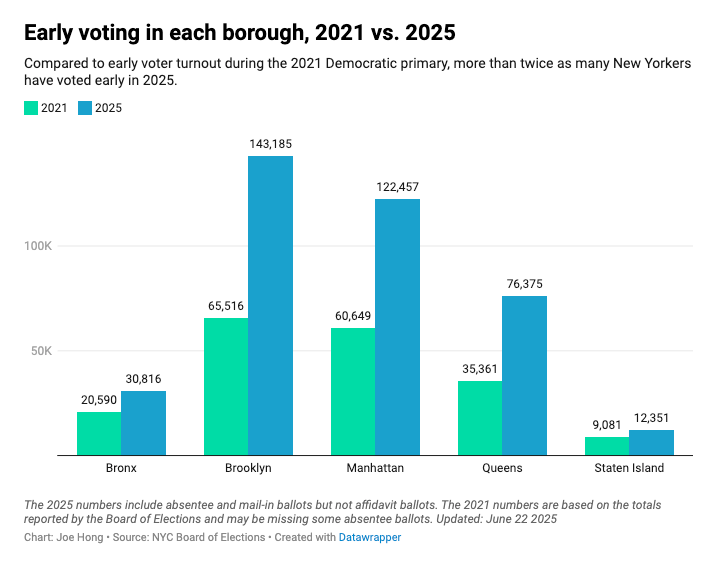
It raised two questions, did young generation showed up because the political message resonate or because they liked the story telling? Is the old way of doing politics dead? the one where to become elected you’ll have to publish one or several books, hour-long debate in gymnasium and town halls. Is this way of politic been algorithmically outcompeted.
Probably a little bit of all of that.
The Return of Enchantment
But why now? Why is storytelling suddenly the dominant mode of political and cultural engagement?
Two forces are converging to make this moment inevitable.
First, AI slop has poisoned the well. The internet is drowning in generated content, generic, optimized, soulless. Trust in digital content has collapsed because anyone can fake anything. We’re swimming in infinite AI-generated mediocrity, and in that ocean, human craft becomes the only signal that cuts through the noise. Authenticity isn’t just valued anymore; it’s the only currency that still works.
Second, economic downturn demands meaning. When material security evaporates, narrative security intensifies. People can’t control inflation, housing costs, or job stability, but they can participate in stories that make them feel less powerless. This isn’t a new pattern, the Great Depression gave us Hollywood’s golden age, postwar anxiety gave us auteur cinema.
This hunger for story hasn’t escaped corporate America’s attention.
Brands Becoming Storytellers
The era of influencer marketing promised authenticity through proxy, brands paid people to tell their stories, to embed products in someone else’s narrative. The logic was simple: consumers don’t trust corporations, but they might trust the person who uses their products.
That model is dying. The new model positions brands as protagonists in their own narratives. The shift is fundamental: from “trust this person who uses our product” to “become part of our world.”
Just as Mamdani didn’t ask voters to trust him, he invited them into scenes they could inhabit, brands are learning the same lesson. The most successful don’t advertise; they create universes with their own aesthetics, values, and narrative arcs. They’re recruiting storytellers.
This trend is moving beyond traditional consumer brands into unexpected territory.
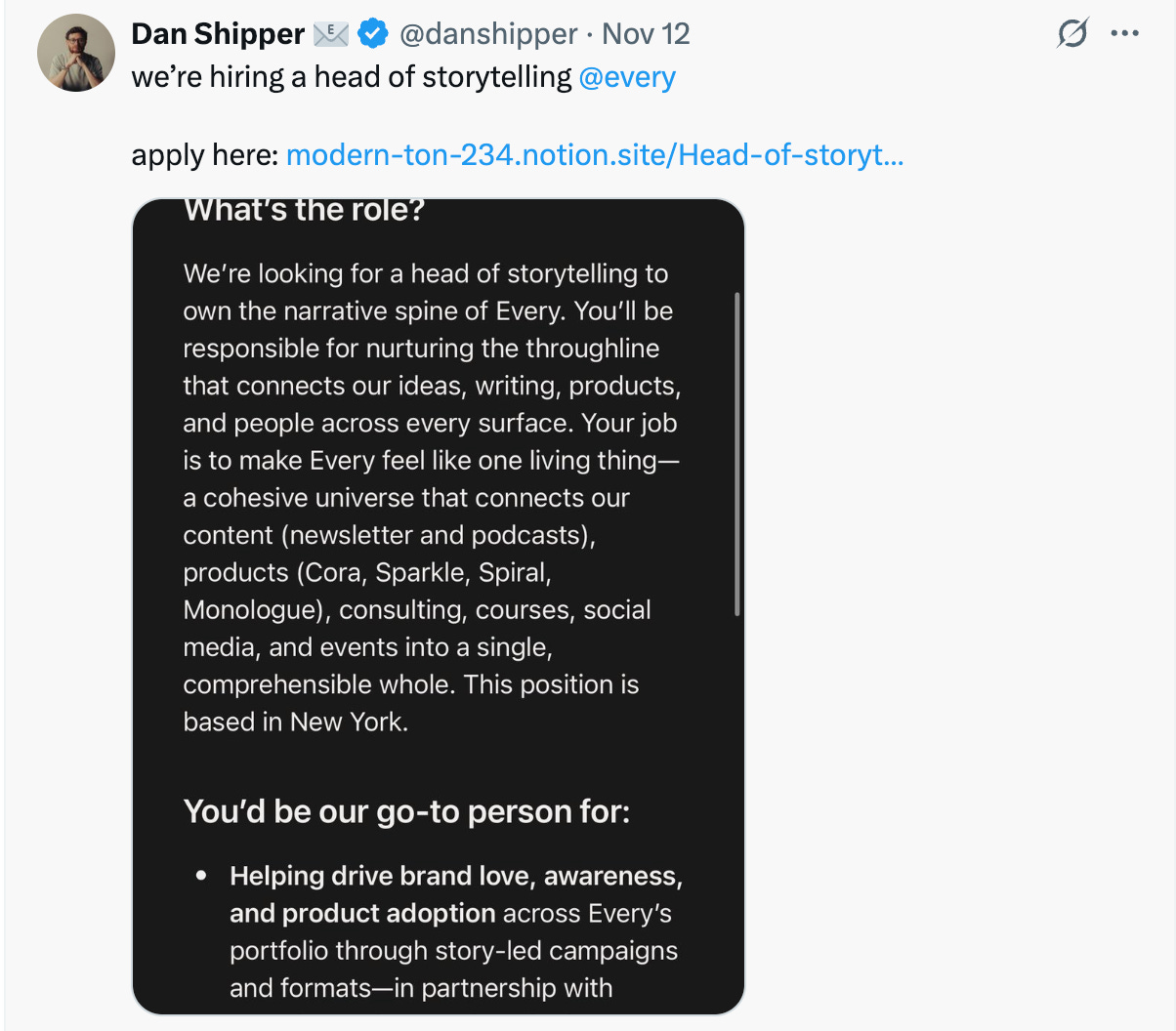
Hospitality’s Narrative Turn
Chefs are launching Substacks. But here’s what’s crucial: they’re not sharing recipes.
They’re documenting vendor relationships, menu development struggles, the 3am doubt that maybe the whole concept is wrong, staff dynamics, the politics of a kitchen, the economics of a tasting menu in a recession. Dan Barber writes about seed breeding. René Redzepi chronicles restaurant closures and mental health. Emerging chef-writers treat their Substacks like behind-the-scenes documentaries running parallel to their restaurants. The value proposition has shifted: transparency as intimacy, process as product.
What’s at Stake
But if storytelling is the answer, we need to ask: storytelling for whom?
The promise is democratic as anyone can tell a story now. Substack, TikTok, Instagram, barriers to distribution have collapsed. You don’t need a publishing deal or a television network. In theory, this is radically democratizing.
The reality is more complicated.
Storytelling takes time, the one resource AI can’t replicate and economic pressure makes increasingly scarce. A chef writing about supplier relationships takes hours away from the kitchen. Mamdani’s campaign required constructing dozens of shareable moments, exponentially more work than buying television ads. Creating a compelling Instagram reel takes 10 minutes; creating a Cinematic Universe takes months of intentional world-building.
The Substack-writing chef and the Cinematic Universe campaign share something beyond aesthetics, they share access to a resource increasingly rare in late capitalism: time. Time to craft, time to iterate, time to build narrative infrastructure while the rent comes due.
This creates a new hierarchy, not based on access to capital or institutions, but on access to time and creative capacity. Who can afford to spend hours crafting narrative when they’re working multiple jobs? Who has the cultural fluency to know what “good story” looks like in 2025? The risk: storytelling becomes a luxury good, available only to those with economic cushion to invest in it.
We’ve replaced “can you afford television ads?” with “can you afford time to craft narrative?”, slightly more democratic, but still exclusionary.
The opportunity: if you do put in the work, you cut through the noise in ways traditional marketing can’t match. In the age of AI slop, human story is the moat. But building that moat requires the one thing late capitalism systematically denies most people: time to create something that matters.
Unfortunately it seem politics has become some form of entertainment. Which is departing from it's actual purpose. Politics was "The study or science of government and how laws and policies are made." It has turned into a soap opera used to gain votes and power. It increasingly looks like Idiocracy was right.